Helping people question a belief without making them defend it
Stuff You Missed in Sunday School was a social advocacy platform about religious transparency. The design problem: how do you help someone question a belief without triggering the reflex that exists to protect it?
Evidence doesn't change minds when it threatens belonging. For believing Mormons, doctrine is family, identity, and eternity. Facts don't land as facts. They land as attacks.
So I stopped arguing and started citing. Official sources only, no commentary, released slowly enough to let the contradiction sit. The goal wasn't persuasion. It was lowering the defenses it triggers.
160+ cards, 4,500+ followers, a 2017 Brodie Award, a Sunstone feature, a published book. What it produced was a repeatable method for belief change without the reflexive shutdown.
Why this is on a design portfolio
This isn't a religious project. It's an emotional design project.
The problem: how do you help someone question something they've built their identity around? Not convince them they're wrong. Not argue with them. Help them sit with dissonance long enough to ask their own questions.
That's a design problem. The methodology (how you sequence information, manage emotional temperature, create space for dissonance without triggering defensive shutdown) transfers to any product where users have to change how they think, not just what they click.
The platform
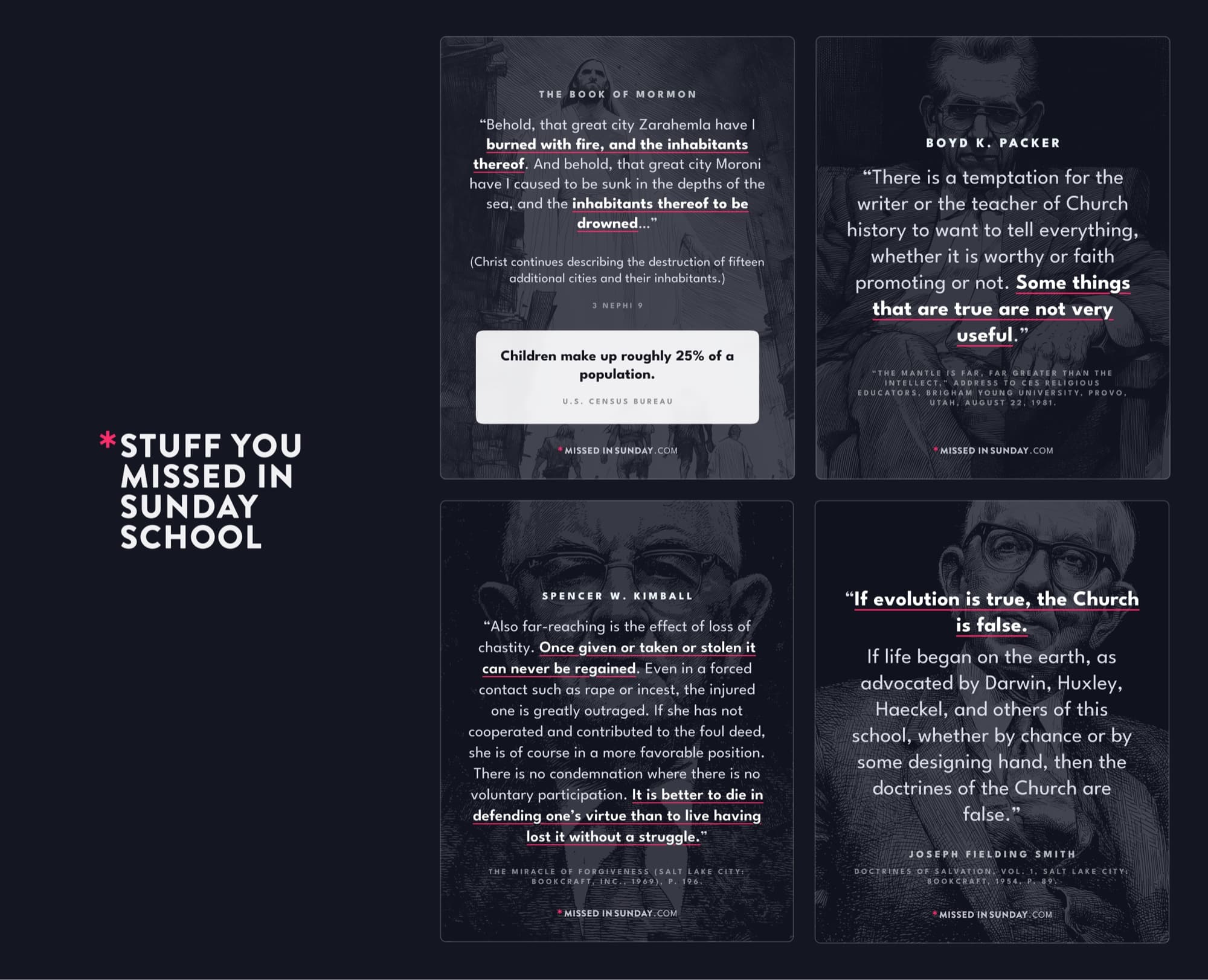
The website (missedinsunday.com) and social media presence distilled complex religious doctrine into sourced, sharable content. Every piece followed the same format: a direct quote from an official church source, properly cited, designed as a sharable card. The tagline I kept coming back to was simple: "How can you break through a belief?"
The content design was the product. Each card was a self-contained unit of cognitive dissonance. A quote from a church leader, fully sourced, presented without editorial commentary. The design of the card itself did the work. The source citation was prominent, not buried. The visual tone stayed serious and respectful. The red asterisk in the logo was the only signal that this wasn't an official church resource.
The cards covered race, gender, polygamy, sexuality, obedience, discipline, and personal worth. Every one sourced from official publications, general conference talks, or canonized texts. The specificity was the entire strategy. Vague criticism bounces off. Sourced internal contradictions don't.
The methodology
Religious belief is a load-bearing structure. It holds up identity, community, family, moral framework, afterlife expectations, daily routine. You can't just pull it out. The person has to build something else before they can let go, and the brain knows this. That's why evidence alone doesn't work. The brain rejects evidence that threatens a load-bearing belief faster than it can read it.
Because I came from inside this culture, I knew the first barrier wasn't ignorance. It was the fear that looking too closely was itself a moral failure. The design had to make that fear less expensive to override.
Step 1: Enter through the existing framework
Meet the audience inside their own worldview, not against it. Every piece of content started by referencing the same texts, the same language, the same values. The person needed to feel understood before they could feel questioned.
Step 2: Introduce contradictions the framework can't resolve
Surface internal inconsistencies, not external critiques. I sourced specific, concrete contradictions from within the audience's own tradition. A contradiction from their own scripture can't be waved off as outsider ignorance the way an outside critique always can.
Step 3: Create space, not conclusions
Leave the dissonance unresolved. The content presented the contradiction and stopped. No mocking, no forced conversion, no closing argument. The design held the silence around the contradiction long enough for the person to find their own answer.
The emotional design layer
Every visual decision had an emotional intent.
Typography. Warm and bookish, not clinical. The type signaled we're thinking together, not I'm proving you wrong.
Color. Dark, archival, restrained. The red accent only marked the contradictory phrase inside the quote. The palette read as primary source material, not attack ad.
Card format. Built for sharing, not reading. Standalone image, citation legible at social-media resolution, source verifiable in under 30 seconds.
Pacing. Slow release. No firehose. Each piece had time to breathe and be discussed before the next one arrived.
Defensibility. The first defense was always going to be "that's anti-Mormon distortion." The citation wasn't supporting metadata. It was the path from "that can't be true" to "I can check this." That path was the whole game.
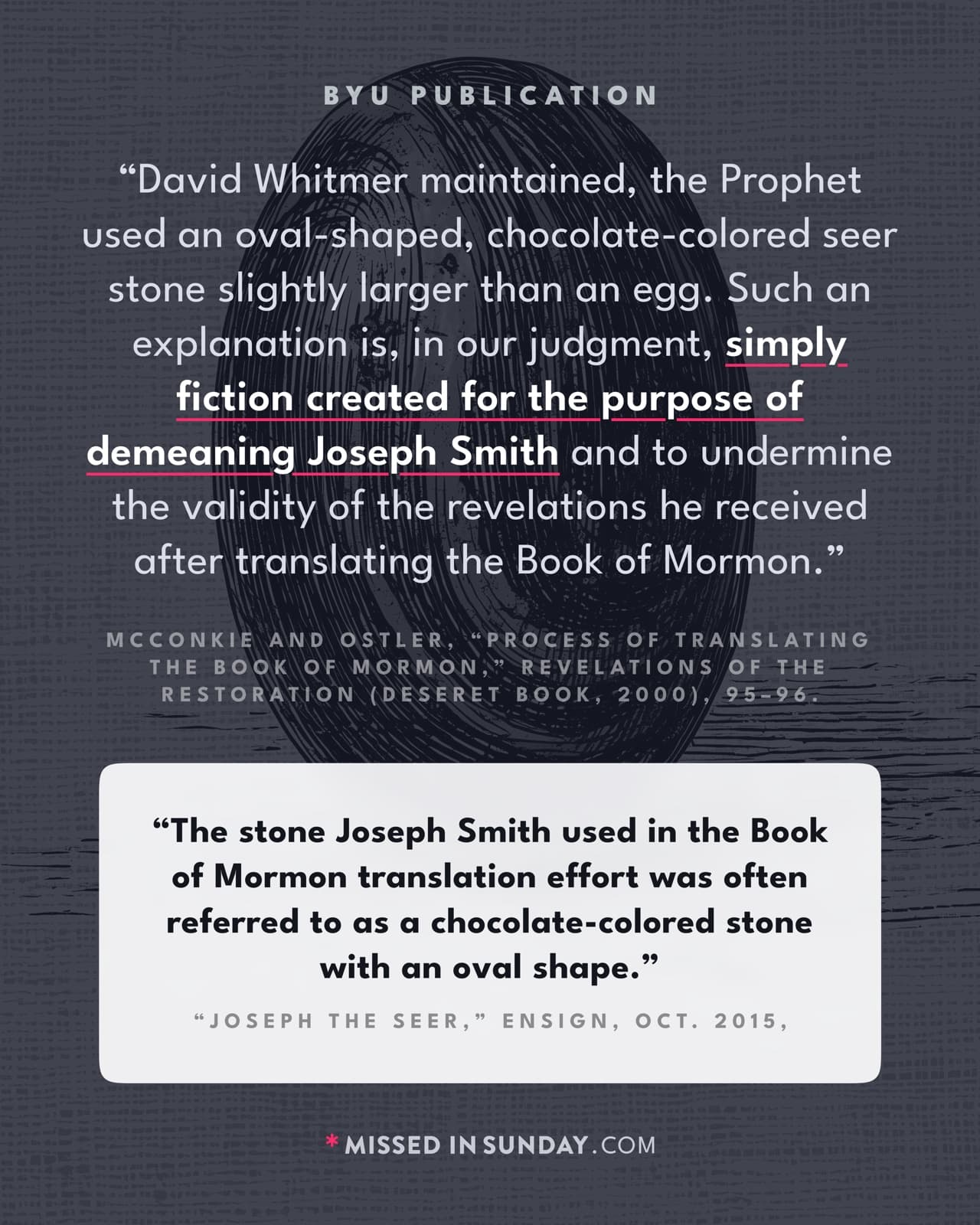
- 01Source authority
Anchors the claim inside an official source. Reduces the first defense before it can fire.
- 02Background treatment
Historical portrait at low opacity. Tonal gravitas without competing with the quote.
- 03Primary quote field
Large, high-contrast type for social-media legibility. The quote is the artifact.
- 04Contradiction marker
A single red underline isolates the tension. The only chromatic note on the card.
- 05Citation block
Publication, year, page. The path from "that can't be true" to "I can check this."
- 06Brand signature
Quiet ownership across a high-volume system. The only marker this isn't official material.
How people used it
Beyond the platform
The project moved beyond social media. I presented at the 2018 Sunstone Symposium, which led to a feature article in Sunstone Magazine, "The Memeing of Mormonism", and the methodology got attention not as advocacy but as a case study in design and persuasion.
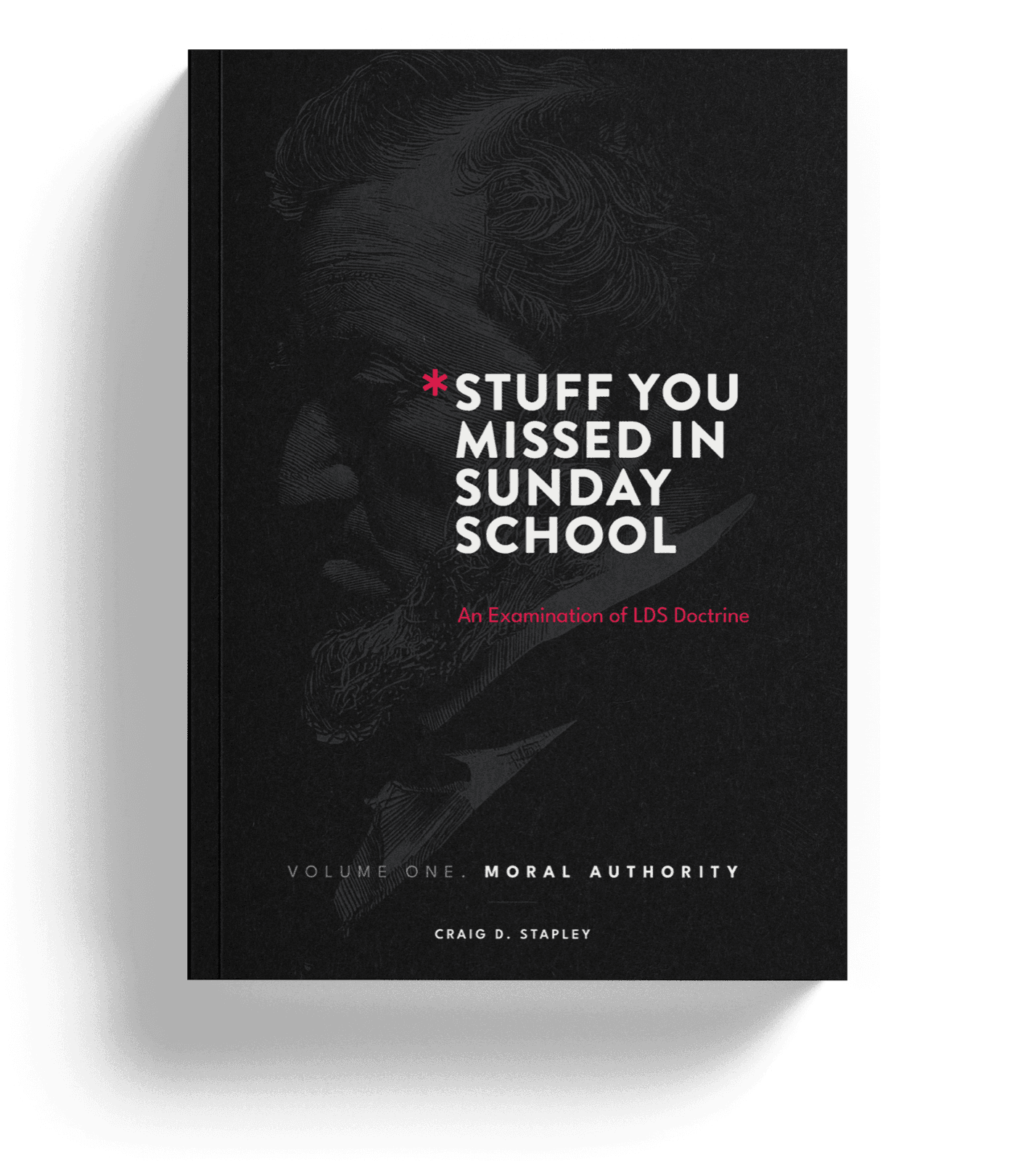
I also wrote and published the book.
After four years inside the work, I handed the platform to a team willing to carry the methodology forward. It still runs at missedinsunday.com.
The transfer
The methodology I built here shows up in everything I design now. Not the religious content. The emotional architecture.
It shows up in how I approach any product where the user resists the thing that would help them: onboarding that asks for vulnerability, health products that surface difficult truths, financial tools that make avoidance visible, AI workflows that challenge existing habits, community products where trust has to be earned before behavior can change. Hiki's consent-first onboarding for neurodivergent users runs on the same principle: enter through the user's existing framework, then introduce the different model.
Meet them where they are. Introduce dissonance from within their own framework. Create space for them to find their own conclusion. Don't close too fast.
Every product I design now has a version of that person in it: the one who resists the thing that would help them. This is where I learned to design for them instead of around them.